



Pediatric Hearing Enhancement, Augmentation, and Restoration (NHEAR) Program
- About Us
- Our Care
- What to Expect
The Gift of Sound
The Nemours Children’s Hearing Enhancement, Augmentation, and Restoration (NHEAR) program takes an integrative and collaborative approach to treating hearing losses of all types. We look for the underlying cause of your child’s hearing loss to determine the best plan of care that will help them reach their full potential.
With a wide range of expertise and experience, our multidisciplinary team will partner with you to enhance your child’s communication potential as they grow — at home, at play, and at school.
Comprehensive Care for Kids With Hearing Differences
Our team of experienced specialists have expertise in helping children with deafness and hearing differences. Whether your child needs speech therapy, hearing restoration with hearing aids, or cochlear implants, we’re here for you.
We provide coordinated care with a multidisciplinary approach to support informed decision making in your child’s care.
Our team includes otolaryngologists (ENT surgeons), pediatricians and advanced practice providers, audiologists, speech language pathologists, social workers, psychologists, therapists, and researchers, working together to ensure we’re meeting both your child’s physical and emotional needs.
We make care convenient for families. We offer complete evaluation at one center, saving families time and enabling our team to work together on the best plan of care for your child.
Our care extends beyond surgery, providing kids with long-term support and resources like our annual cochlear implant summer camp.

“There is absolutely nothing in the world like hearing rain for the first time.”
“My daughter’s experience with her team of doctors and medical staff has been nothing short of amazing.”
“Don’t give up. Do what it takes, even if it means traveling to find the best possible care.”
- Slide 1
- Slide 2
- Slide 3
Meet Our Ear Specialists
Our specialists are at the forefront of their fields. They work tirelessly to improve the quality of life for children and young adults with ear conditions.
A Holistic Approach to Care
Our multidisciplinary team works together to develop treatments that meet each child’s unique needs and each family’s specific goals.
Your child’s care plan may include:
- Audiology to measure and treat hearing loss and balance system differences
- Ear, nose, and throat or “ENT” (otolaryngology) to diagnose hearing loss and inner ear disorders, and provide reconstructive hearing surgeries such as bone conduction implants, cochlear implants, and gene therapy
- Plastic surgery to treat outer ear differences using advanced surgical techniques
- Developmental pediatrics to evaluate your child’s progress in multiple physical, cognitive, emotional, and social domains
- Genetic testing and counseling to look for a genetic (inherited) cause of an ear difference and help you understand how your family may be affected
- Ophthalmology to treat eye disorders that may also occur in children with ear differences
- Psychology to help your child if they experience emotional problems
- Speech and language therapy to evaluate and treat speech problems and facilitate language growth (English and Spanish)
- Support services such as social work, interpreter services and school resources
- Child Life program offers kid-friendly activities to reduce fears and help your child prepare for surgery
Conditions & Treatments
We treat a wide range of hearing conditions, from the most common to the most complex. Don’t see a condition listed? Call us.
Related Specialties & Programs

Convenient Video Appointments
We offer new and follow-up appointments through scheduled, live video visits. You can avoid waiting rooms and save travel time. Ask your doctor if this is an option for your family.
What to Expect
Cochlear implant surgery is typically a three-phase treatment, consisting of the procedure, postoperative audiology appointments, and auditory verbal therapy.
While every child’s specific treatment and timeline may vary, here’s generally what you can expect from each of these phases.
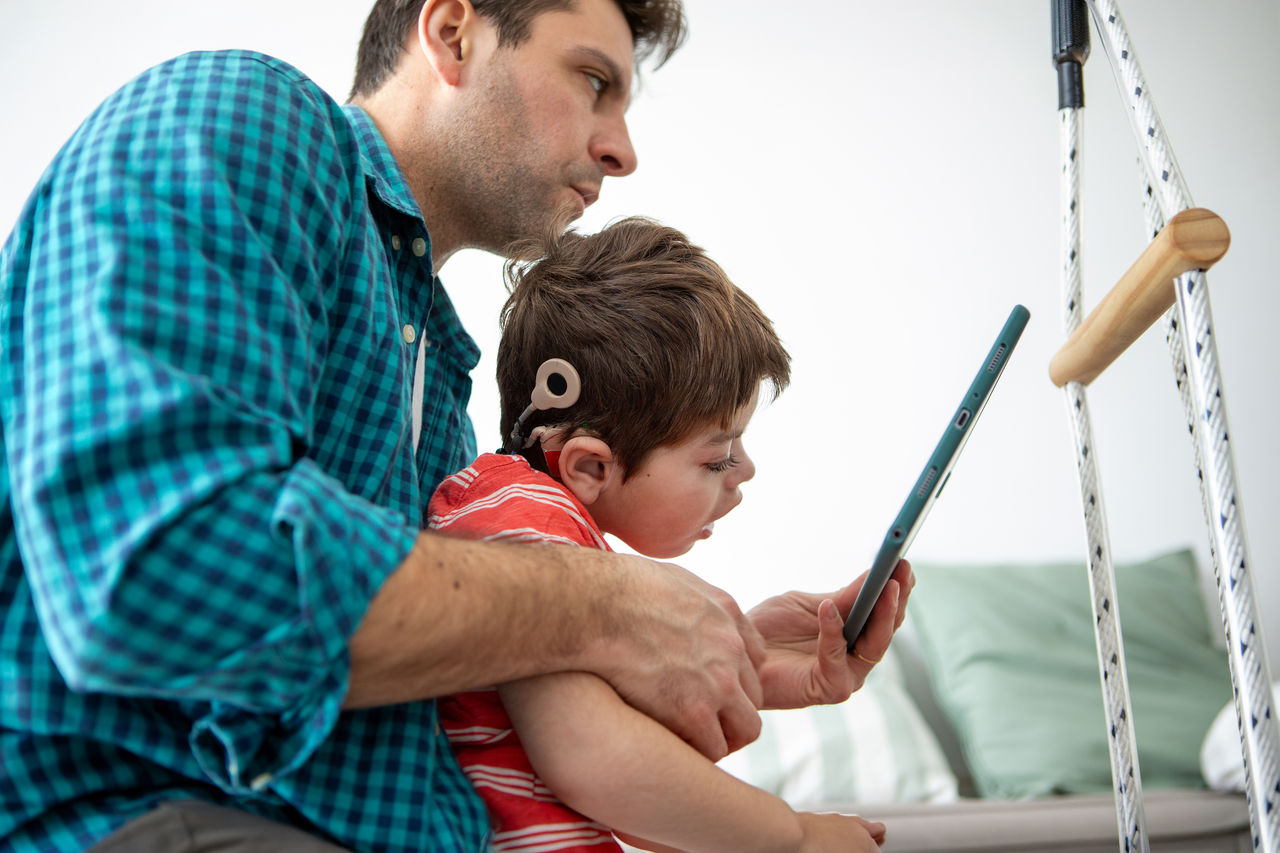
A cochlear implant is a small electronic device that can help your child hear and understand speech better. It’s made up of a processor that’s worn behind the ear and an electrode array, magnet, and computer chip that are placed inside your child’s inner ear.
Cochlear implant surgery is not painful. Your child will receive general anesthesia, so they will be in a deep sleep during the procedure and will not feel anything.
The surgery usually takes 2 to 3 hours. Most children go home the same day and are able to return to school in about a week.
Here’s What Happens
- The surgeon will cut the skin behind the ear and make a hole in the bone.
- The internal part of the device is inserted into the cochlea (inner ear) and the surgeon closes the skin.
- Your child’s head will be wrapped with a pressure bandage to reduce swelling. This bandage will be removed the next day.
- About 3 weeks after surgery, your child will have a follow up with the audiologist where they will be fitted for the external cochlear implant processor and magnet. Your child will be able to wear the cochlear implant home from this appointment.
Your child will need Auditory Verbal Therapy for at least a year after surgery to learn to hear and speak with the cochlear implant. We will discuss this with you ahead of surgery.
Receiving a cochlear implant requires consistent and frequent follow-up appointments to help your child reach their full potential.
Here’s What Happens
- 2 weeks after surgery, you and your child will meet with a representative from your child’s cochlear implant manufacturer to review the equipment, how it works, and how to take care of it. This appointment can be done virtually or in-person.
- 3 weeks after surgery, your child will have a follow up with their audiologist where their cochlear implant will be activated. Your child will be fitted for the external cochlear implant processor and magnet, the implant will be turned on with a computer, and we’ll set the loudness levels by seeing how your child reacts to sound.
- 2 weeks after activation, your child will have a follow-up to ensure everything is working properly. This appointment can be done virtually or in-person.
- 1 month after activation, your child will have a second follow-up. After this, your child will have regularly scheduled visits every 3 months for the first year, then every 6 months, until tapering down to annual follow-ups. These appointments may be done virtually or in-person.
After receiving a cochlear implant, your child will require auditory verbal therapy for at least a year. This intensive, long-term rehabilitation program helps your child develop listening, language, speech production, and communication skills. It’s vital to ensuring your child’s success with their cochlear implant.
Here’s What Happens
- Prior to cochlear implant surgery, your child will complete a listening and spoken language evaluation. Communication modalities, realistic expectations, and required follow-ups will be discussed at this session.
- Weekly therapy sessions will begin after cochlear implant surgery is complete. While the implant provides your child the ability to access sound, this therapy is necessary to teach them to listen and understand the sound.
- Every 5-6 months after surgery, a re-evaluation will be completed to assess current levels of listening and spoken language skills. We’ll adjust your child’s care plan accordingly. These appointments may be done virtually or in-person.
- 6 months after discharge from therapy, we recommend your child completes a listening and spoken language evaluation to monitor development and determine if any further services are needed.
Information and Advice From Nemours KidsHealth®
Learn more about your child’s condition and how we treat it.